
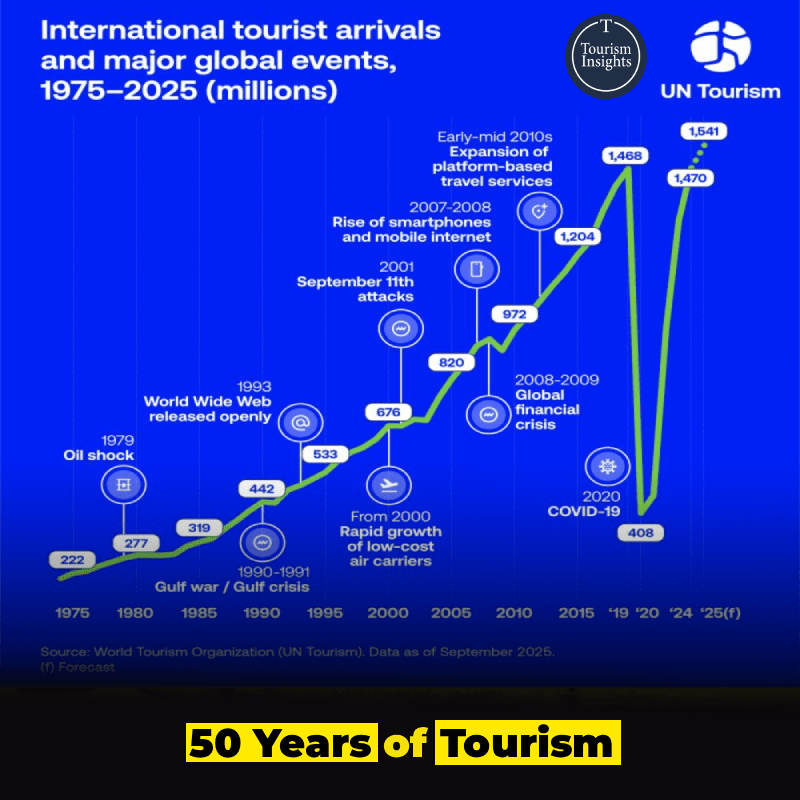
The year 2025 marks fifty years since the creation of the World Tourism Organization, underscoring five decades of multilateral cooperation in tourism at a time when global challenges increasingly require stronger governance, coordinated policies, and collective action. Over this period, tourism has transformed from a relatively small activity into a major pillar of the global economy and a key driver of social and economic development. International tourist arrivals expanded from 222 million in 1975 to around 1.5 billion in 2025, while export revenues from international tourism grew from approximately USD 50 billion to a projected USD 2.2 trillion, reflecting tourism’s scale and resilience. Tourism’s direct contribution to global GDP increased significantly between 2008 and 2023, with international travel expenditure growing even faster, driven by economic growth, rising purchasing power in emerging markets, lower transport costs, digitalization, new business models, visa facilitation, and changing consumer behavior.
For many countries, particularly small island developing states and former least developed countries such as Cabo Verde, the Maldives, Samoa, and Vanuatu, tourism remains a central source of foreign exchange, employment, and economic stability, demonstrating its role in reducing inequality among nations. Despite repeated shocks, international tourism has shown remarkable resilience, with most crises causing only short-lived downturns. Following the unprecedented disruption of COVID-19, UN Tourism forecasts international arrivals to reach 2.0 billion by 2030, supported by strong recovery momentum, connectivity, infrastructure investment, and digital transformation.
Beyond its economic value, tourism fosters cultural exchange, dialogue, and mutual understanding, while also holding potential to support the conservation of natural and cultural heritage when effectively managed. However, continued growth without adequate planning risks placing pressure on communities, ecosystems, and resources. Ensuring that tourism works for good requires a fundamental shift in governance and policy approaches, placing communities and nature at the center, strengthening evidence-based planning, improving foresight, and establishing robust systems for monitoring and evaluation to prepare the sector for a more sustainable and inclusive future.