
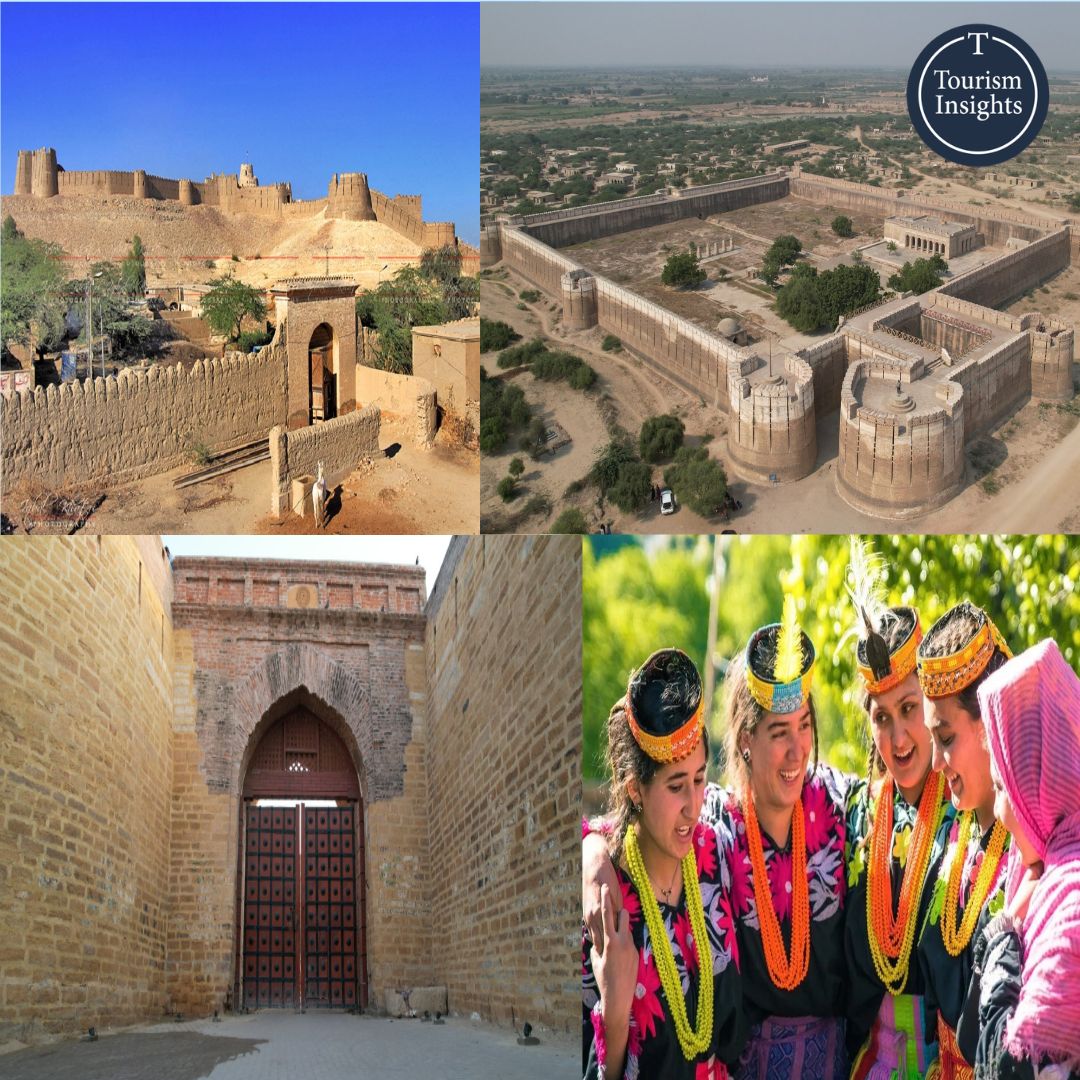
The Kalash valleys in Khyber Pakhtunkhwa are among four heritage sites in Pakistan added to the Unesco World Heritage Tentative List, marking a milestone in heritage conservation, it emerged on Tuesday. The other three sites are the Kot Diji, Naukot and Umerkot forts in Sindh.
With these additions, the number of heritage sites in Pakistan on the Tentative List has increased from 25 to 29.
According to Unesco’s website, a country must prepare an inventory of important natural and cultural heritage sites within its boundaries, known as the Tentative List. “It is an important step since the World Heritage Committee cannot consider a nomination for inscription on the World Heritage List unless the property has already been included on the State Party’s Tentative List,” it says.
Kalash — an enclave of three remote and inaccessible valleys of Bumburet, Birir and Rumbur — is located in KP’s Chitral district and is inhabited by over 4,000 indigenous people who profess a polytheistic religion and maintain unique cultural practices.
KP Director General of Archaeology and Museums Dr Abdul Samad told Dawn that the development was a significant achievement towards the preservation of Kalash culture. “It is the first time an entire community and its cultural practices have been included on the Unesco Tentative List,” he said.
He said his department had been working for more than a decade to have the Kalash cultural landscape placed on the UN agency’s heritage list. He said the enlistment would contribute to the preservation of both the tangible and intangible aspects of Kalash culture.
Dr Samad explained that the first step involved acceptance of a submission by the World Heritage Centre on the Tentative List, followed by formal notification by the UN body. However, he added that after tentative enlistment, a dossier must be submitted to the UN body, incorporating bylaws and other necessary requirements.
He said inclusion on the Tentative List had placed Kalash culture on the national and international cultural map, facilitating bylaws, community development, and preservation of tangible and intangible heritage; therefore, it was a major achievement.
KP Governor Faisal Karim Kundi, in a post on X, welcomed the development, terming it a “major milestone”. He noted that KP was “home to some of the world’s most breathtaking landscapes and unique cultural traditions, and this recognition is long overdue”. “A well-deserved moment that brings global attention to the beauty and heritage of our region,” he added.
According to Unesco’s website, “The Kalasha Valley cultural landscape possesses outstanding universal value (OUV) as an extremely rare and exceptionally well-preserved example of a living indigenous cultural system.”
It said this system has continued without interruption for centuries within its original geographic and cultural setting. Despite historical changes, outside influences, and social pressures, the Kalasha community has successfully maintained its distinct identity.
“These features are not abstract ideas or symbolic references to the past, as they are actively practised and clearly connected to the physical landscape, where specific places serve as designated locations for particular ceremonies and ritual activities. The landscape itself is directly involved in sustaining and expressing cultural life.”
It said the tangible heritage includes more than 140 recorded ceremonial structures, ritual platforms, ancestral graveyards featuring distinctive wooden carvings, and traditional villages. Each of these places has its own name, purpose and meaning within the memory and identity of the community.
A vital step
Dr Tahir Saeed, former director at the Department of Archaeology and Museums, said the inclusion of four sites was a vital step towards future nominations to the prestigious World Heritage List.
Dr Saeed, who was engaged by the archaeology departments of Sindh and KP to prepare and submit proposals to Unesco, told Dawn that the inclusion strengthens Pakistan’s position in global heritage conservation.
According to him, an evaluation team from the World Heritage Centre is expected in August/September this year to inspect the Port of Bhambhor, following Pakistan’s request to include the site — dating from the first century BC to the 13th century AD — in the World Heritage List.
“If approved by the evaluation team, the Port of Bhambhor could be added to the list by 2027,” he said, adding that he had prepared the nomination dossier.
The last time a property of archaeological significance from Pakistan was declared a World Heritage Site was nearly three decades ago. “Rohtas Fort was included in the World Heritage List in 1997,” he said.
Pakistan currently has six sites on the World Heritage List: Lahore Fort and Shalimar Gardens, Taxila, the remains of Makli Necropolis, Takht-i-Bahi, Mohenjo Daro, and Rohtas Fort.
The last time Unesco accepted Pakistan’s request to include properties on the Tentative List was a decade ago, in 2016.
Source: DAWN E-PAPER